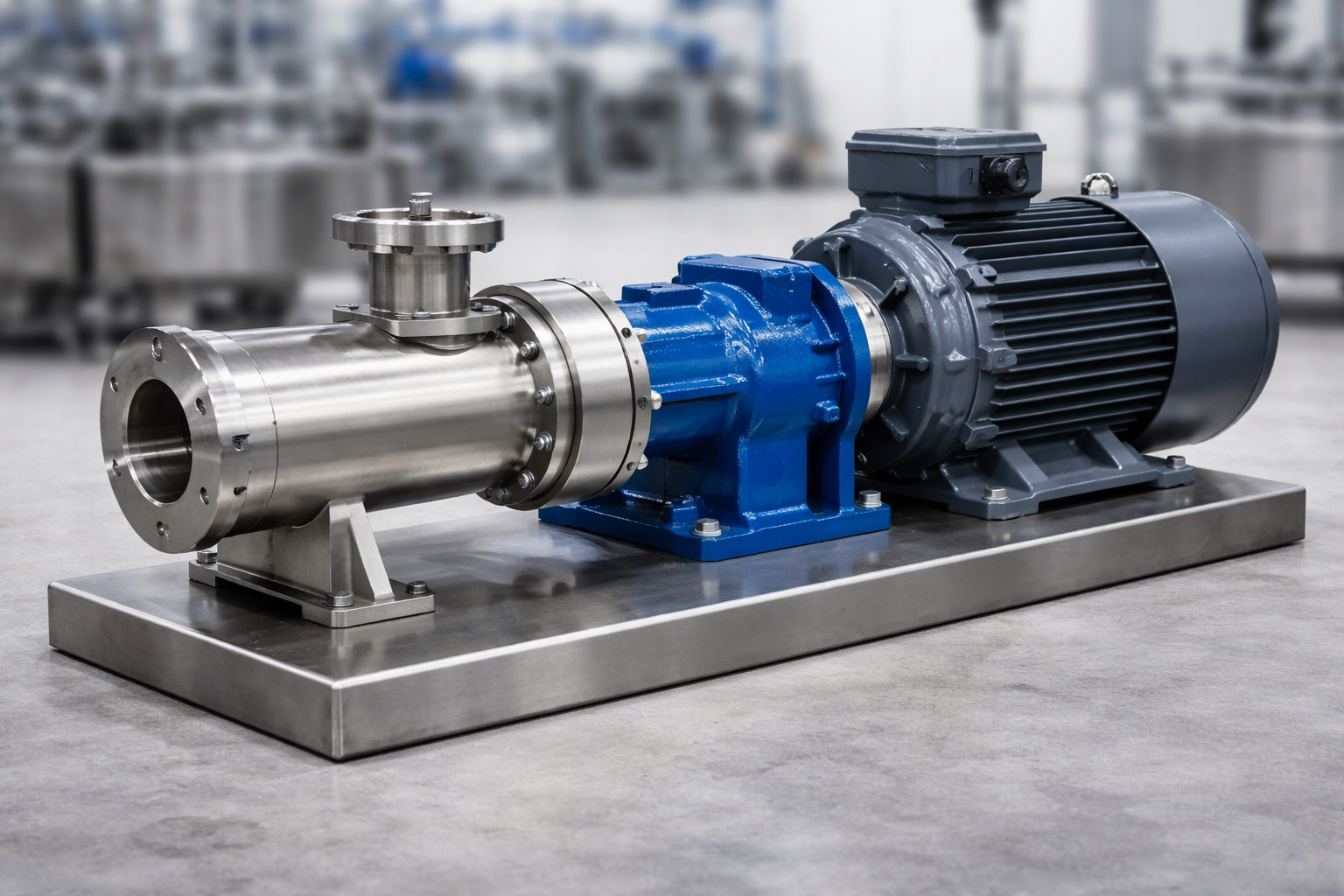
The Ultimate Screw Pump Guide: Engineering for Industrial Fluid Handling
Introduction
Screw pumps represent one of the most reliable and versatile positive displacement technologies available to industry today. Unlike centrifugal pumps, which can struggle with viscous fluids, screw pumps excel in moving thick, abrasive, or shear-sensitive materials with consistent, pulsation-free flow. This guide provides a comprehensive overview of screw pump technology, covering types, applications, selection criteria, and compliance standards that matter to operators and engineers across the continent.
What Is a Screw Pump?
A screw pump is a positive displacement rotary pump that uses one or more helical screws to transfer fluid along the pump’s axis. As the screws rotate, they form enclosed cavities that trap the fluid and move it smoothly from the suction port to the discharge port. This principle ensures a steady, non-pulsating output, making screw pumps ideal for applications where flow stability is critical.
Main Types of Screw Pumps
Progressive Cavity Pumps (Single-Screw)
Progressive cavity pumps consist of a single helical rotor turning inside a flexible or rigid stator with a double internal helix. The interaction between the rotor and stator creates moving cavities that transport the fluid. These pumps dominate the market, holding approximately 55 % of global screw pump sales, due to their exceptional ability to handle high-viscosity fluids, slurries, and fluids with entrained solids.
In Europe, progressive cavity pumps are widely used in wastewater treatment, food processing, chemical dosing, and agricultural applications. Chinese manufacturers offer configurations with cast iron, stainless steel, and duplex steel materials to meet EN and DIN specifications.
Twin-Screw Pumps
Twin-screw pumps feature two intermeshing screws rotating in opposite directions within a close-fitting casing. They can handle both lubricating and non-lubricating fluids and are often chosen for their ability to operate at higher speeds and pressures compared to progressive cavity designs.
These pumps are common in the European oil and gas industry, marine applications, and refinery services. Most twin-screw pumps supplied in Europe comply with API 676 and ATEX directives where explosive atmospheres are a concern.
Three-Screw Pumps
Three-screw pumps consist of one driven power screw and two idler screws. This design provides balanced hydraulic forces, reducing vibration and extending service life. These pumps are typically used in hydraulic systems, lubrication circuits, and fuel transfer applications across European industrial sectors.
European Standards and Compliance
When selecting a screw pump for operations within Europe, compliance with established standards is not optional — it is a requirement for safety, performance, and legal operation.
| Standard |
Scope |
| EN 809:1998+A1:2010 |
Safety requirements for liquid pumps and pump units |
| EN 12259-12 |
Requirements for pumps used in fire protection systems |
| API 676 |
Positive displacement rotary pumps — widely adopted in European oil and gas |
| ATEX Directive 2014/34/EU |
Equipment for potentially explosive environments |
| VDMA 24284 |
Energy efficiency classification for pumps |
Chinese manufacturers consistently design their screw pumps to meet or exceed these standards, ensuring that end-users receive equipment that is safe, durable, and efficient.
U.S. Standards for Screw Pumps
For businesses operating in or supplying to the American market, compliance with U.S. standards is essential. The regulatory landscape in the United States is shaped by several key organizations, each with a specific focus, from safety and performance to materials and manufacturing practices.
American Petroleum Institute (API)
In the oil, gas, and petrochemical sectors, the API 676 standard is the most critical specification for rotary positive displacement pumps, including screw pumps . Published by the American Petroleum Institute, this standard establishes minimum requirements for the design, manufacturing, and testing of these pumps for use in demanding industry services .
Key requirements of API 676 include:
- Design Life: Pumps are generally expected to be designed for a 20-year life cycle, with major maintenance intervals of no less than three years .
- Materials: Cast steel is specified as the minimum material of construction for wetted parts .
- Reliability: Bearings must have a minimum L-10 life of 25,000 hours .
- Testing: The standard mandates a series of rigorous tests, including hydrostatic, performance, four-hour run, vibration, and sound testing .
- Baseplate and Couplings: Baseplates must be rigid with machined mounting surfaces, and metal disc-type couplings are required .
Many manufacturers, produce screw pumps that are API 676 compliant, often with additional certifications like ATEX for explosive atmospheres . Compliance is often a prerequisite for contracts in the U.S. oil and gas industry, and many specifications for screw pumps explicitly reference the latest edition of API 676 .
American National Standards Institute (ANSI)
ANSI standards ensure that pumps are designed for interchangeability and performance consistency across different manufacturers. For screw pumps, the key standard is ANSI B73.2, which covers specifications for chemical process screw pumps . Other related standards like ANSI B16.5 are frequently referenced for flange dimensions and pressure ratings in pump packages .
Additional U.S. and International Standards
Other important standards and organizations that are commonly referenced in the U.S. market include:
- Hydraulic Institute (HI): The ANSI/HI 3.6 standard provides comprehensive guidelines for the design, installation, operation, and maintenance of rotary screw pumps .
- American Society of Mechanical Engineers (ASME): ASME standards, such as ASME Section VIII for pressure vessels and ASME Section IX for pipe fabrication, are often applied in pump skid and system design, alongside piping standards like ANSI B31.1 and B31.3 .
- National Electrical Manufacturers Association (NEMA): NEMA standards govern electric motor enclosures and performance, frequently specified in pump packages for the U.S. market .
A Comparative Overview of U.S. Standards
| Standard |
Scope |
Typical Application |
| API 676 |
Rotary positive displacement pumps (gear, screw, vane) |
Oil & gas, petrochemical, heavy industry |
| ANSI B73.2 |
Chemical process screw pumps |
| Chemical processing, general industry |
|
| ANSI/HI 3.6 |
Design, installation, operation, and maintenance of rotary screw pumps |
| General industry, water/wastewater |
|
| ASME Section VIII |
Pressure vessel design and construction |
Pump package systems with pressure-containing components |
| ANSI B31.3 |
Process piping design |
| Piping systems connected to pumps |
|
By adhering to these U.S. standards, manufacturers and end-users can ensure a baseline of safety, reliability, and performance for screw pumps in the American market, facilitating trade and operational efficiency.
How to Select the Right Screw Pump
Choosing the correct screw pump for your application requires careful evaluation of several factors.
Fluid Characteristics
Start by analysing the fluid you intend to pump. Consider viscosity — progressive cavity pumps handle viscosities up to several million centipoise, while twin-screw pumps are better suited for lower ranges. Also evaluate temperature, abrasiveness, corrosiveness, and the presence of solids or entrained gas.
Performance Parameters
Define your required flow rate and discharge pressure. Screw pumps offer a wide performance envelope, but each type has optimal operating windows. Oversizing leads to unnecessary energy consumption, while undersizing results in premature wear and frequent breakdowns.
Material Selection
European manufacturers typically offer a range of materials that comply with EN standards. For standard applications, cast iron bodies with stainless steel rotors are common. For corrosive or hygienic applications, full stainless steel construction (1.4404 or 1.4301 grades) is preferred. Bronze components are also available for seawater and aggressive chemical environments.
Operational Environment
Consider whether the pump will be installed indoors or outdoors. European winters demand pumps that can handle low ambient temperatures. If the installation site is classified as hazardous, ATEX-certified pumps are mandatory.
Key Industries and Applications in Europe
Screw pumps serve a broad spectrum of industries across Europe.
Water and Wastewater Treatment
Municipal and industrial wastewater facilities rely heavily on progressive cavity pumps for sludge transfer, dewatering, and chemical dosing. The ability to handle abrasive solids and fibrous materials makes these pumps indispensable in this sector.
Oil and Gas
From crude oil transfer to emulsion handling and waste oil processing, screw pumps are a cornerstone of the European oil and gas industry. Twin-screw and three-screw designs are particularly prevalent in offshore and onshore installations.
Food and Beverage
Hygienic screw pumps with stainless steel construction and CIP (Clean-in-Place) capabilities are standard in European dairies, breweries, and food processing plants. Shear-sensitive fluids like yoghurt, fruit concentrates, and sauces are handled without quality degradation.
Chemical and Pharmaceutical
Precision dosing and transfer of aggressive, viscous, or shear-sensitive chemicals require screw pumps built from corrosion-resistant alloys. European chemical plants rely on these pumps for consistent, leak-free operation.
Energy Efficiency and Sustainability
Energy efficiency has become a primary focus across European industry, driven by regulatory frameworks such as the EU Ecodesign Directive. Modern screw pumps incorporate optimised rotor-stator geometries, advanced bearing systems, and high-efficiency motors to reduce power consumption.
Many manufacturers now offer pump systems with integrated variable frequency drives, allowing operators to match pump output precisely to process demand. This approach significantly reduces energy waste and extends equipment life.
Maintenance Best Practices
Proper maintenance ensures long service life and reliable performance from your screw pump.
Routine Inspections
Regularly inspect stator and rotor surfaces for signs of wear, especially when pumping abrasive slurries. Monitor seal integrity and check for any abnormal vibration or temperature rise during operation.
Seal Management
Mechanical seals are the most common sealing solution in screw pumps. Depending on the application, single or double mechanical seals are available. For extreme conditions, packed gland seals may be specified. Always follow the manufacturer’s recommendations for seal replacement intervals.
In-Place Servicing
Leading pump manufacturers have developed designs that permit servicing without disconnecting pipework. This feature drastically reduces downtime and maintenance costs, which is particularly valuable in continuous-process industries.
Conclusion
Screw pumps are an indispensable technology for industries that handle challenging fluids. By understanding the different types of screw pumps, the applicable standards, and the key selection criteria, you can make informed decisions that improve operational efficiency, reduce costs, and ensure regulatory compliance.
Whether your application involves wastewater, crude oil, food products, or chemicals, there is a European-built screw pump engineered to meet your needs with reliability and precision.
Need Professional Assistance?
The team Beijing XLHJ International of pumping specialists is available to help you select, specify, and source the right screw pump for your operation. Contact us today for expert advice and competitive quotations tailored to your project requirements.






 18.9.2026