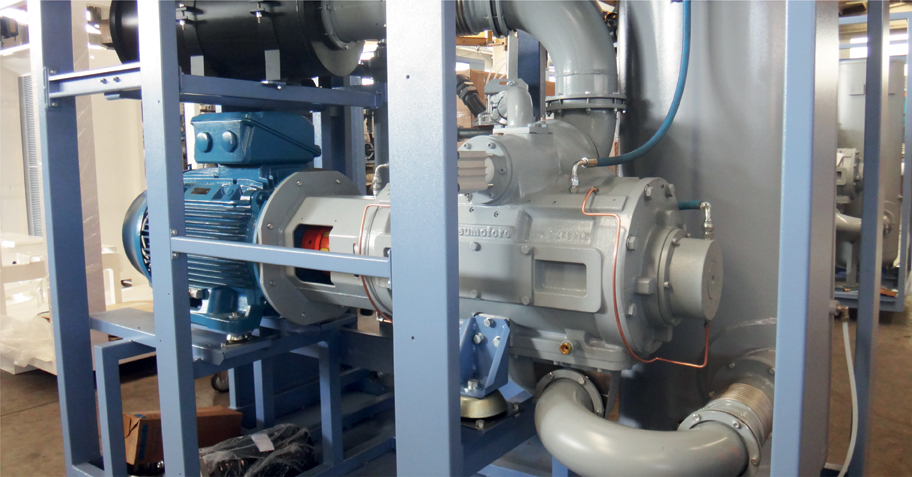

Industrial Rotary Vane Vacuum Pump Guide: Technical Selection & Global Applications

breadcrab News
Sections
news news
Industrial Rotary Vane Vacuum Pump Guide: Technical Selection & Global Applications

Introduction

In demanding industrial environments, the rotary vane vacuum pump remains a cornerstone technology for generating reliable vacuum across countless applications. From semiconductor manufacturing and pharmaceutical R&D to chemical processing and metallurgy, these pumps deliver the performance and durability that industrial operations require.

Rotary vane vacuum pumps operate on a simple yet effective principle: a rotor with sliding vanes rotates within a cylindrical chamber. As the rotor turns, the vanes slide in and out, creating expanding and contracting volumes that draw in, compress, and exhaust gas. Available in both oil-lubricated and dry-running configurations, these pumps offer a proven balance of performance, reliability, and cost-effectiveness.

This guide provides industrial engineers and procurement specialists with the technical knowledge needed to select the right rotary vane vacuum pump for specific applications, with consideration for regional market demands across Africa, the USA, Europe, and Latin America.


Understanding the Technology

How Rotary Vane Pumps Work

The pump’s rotor, mounted eccentrically within the stator, contains slots that hold spring-loaded or centrifugal vanes. As the rotor spins, the vanes maintain contact with the chamber wall, creating sealed compartments. Gas enters through the inlet port, is trapped between vanes, compressed as the volume decreases, and expelled through the outlet.

Oil-Lubricated vs. Dry Designs

  • Oil-Lubricated (Oil-Sealed) Pumps: Use oil for sealing, lubrication, and cooling. These achieve deeper ultimate vacuum levels (down to 10⁻⁴ Torr with two-stage designs) and offer superior protection against particulates and vapors. However, they require regular oil changes and present a risk of oil carryover in sensitive processes.

  • Dry (Oil-Free) Pumps: Utilize self-lubricating graphite vanes, eliminating oil contamination risk and reducing maintenance frequency. These are ideal for applications where process purity is critical, though they generally achieve higher ultimate pressures (120-150 mbar(a)).

Single-Stage vs. Two-Stage

  • Single-Stage: More economical, suitable for rough vacuum applications down to ~10⁻² Torr.

  • Two-Stage: Achieve deeper vacuum (down to ~10⁻⁴ Torr) through a second pumping stage, essential for freeze-drying, mass spectrometry, and electron microscopy.


Key Technical Specifications for Selection

1. Pumping Speed (Flow Rate)

Measured in m³/h or CFM, pumping speed determines how quickly a system can be evacuated. Industrial applications typically require speeds from 5 m³/h up to 140 m³/h or higher. For larger systems, higher flow rates are essential to minimize evacuation time.

2. Ultimate Vacuum Pressure

This is the lowest pressure the pump can achieve in a sealed system. For most industrial processes requiring fine vacuum, two-stage oil-sealed pumps are necessary. Single-stage pumps generally suffice for rough vacuum applications.

3. Duty Cycle and Operational Intensity

For continuous 24/7 industrial operations, heavy-duty pumps designed for constant use are non-negotiable. Intermittent use applications may tolerate standard-duty units, but continuous operation demands robust thermal management and superior build quality to prevent premature failure.

4. Gas and Vapor Compatibility

Standard pumps handle air and inert gases. Processes involving corrosive chemicals, solvents, or high moisture loads require corrosion-resistant models with specialized seals and internal coatings. The gas ballast feature, particularly advanced three-stage designs, improves water vapor tolerance in humid production environments.

5. Environmental and Operational Conditions

Consider ambient temperature ranges, permissible operating temperatures, and noise levels. Industrial-grade pumps typically operate in 0-40°C ambient conditions with noise levels ranging from 50-77 dB(A) depending on size and configuration.


Regional Market Considerations

United States & Europe

Mature, well-established markets driven by automotive, healthcare, and electronics industries. Environmental regulations in Europe (e.g., European Green Deal) increasingly favor energy-efficient and dry-running technologies. North American markets benefit from industrial automation trends and infrastructure development initiatives. Engineers in these regions should prioritize pumps with IE3 energy-efficient motors and low total cost of ownership.

Latin America

Moderate growth markets with emerging opportunities in oil & gas and chemical processing sectors. Growing investments in manufacturing and energy sectors are driving demand. Pumps with corrosion resistance for aggressive chemical environments are particularly relevant for processing industries in this region.

Africa

Steady growth propelled by infrastructure development and expanding industrial sectors. Markets in South Africa, Nigeria, and Egypt show particular potential. Pumps suitable for challenging environmental conditions and capable of continuous operation are recommended for African industrial applications.


Total Cost of Ownership Considerations

While rotary vane pumps generally offer lower initial investment compared to alternatives like claw pumps, maintenance costs must be factored into purchasing decisions.

Maintenance Requirements

  • Oil changes typically required every 3,000 hours of operation

  • Regular vane replacement needed over pump lifespan

  • Service intervals may be shorter due to constant friction of moving vanes

Cost-Saving Features to Consider

  • Sight glass for easy oil level monitoring

  • Standard drain valves for frequent oil changes

  • Patented oil housing designs that reduce oil temperature and extend oil service life

  • Accessible designs that minimize pump downtime during maintenance


Selection Framework

Selection Factor Recommended Approach
Continuous Operation Heavy-duty industrial grade, oil-lubricated for reliability
Intermittent Use Standard-duty, lower-cost pump
Corrosive Gases Corrosion-resistant model with specialized seals
High Humidity Advanced gas ballast feature (e.g., 3-stage)
Deep Vacuum Required Two-stage oil-sealed pump
Rough Vacuum Only Single-stage pump
Process Purity Critical Dry-running pump
Budget-Conscious Standard oil-lubricated pump for general duty


Why Choose Beijing XLHJ International

Beijing XLHJ International specializes in supplying high-quality Chinese-manufactured industrial vacuum pumps that meet international standards. Our team of experienced engineers understands the technical demands of diverse industrial applications across global markets.

Our expert engineers conduct precise selection to ensure your pump perfectly matches your application requirements. We provide competitive pricing and favorable purchasing terms for industrial customers worldwide. Contact us for personalized technical consultation and quotes.